Romanian GCSE UK: Why Thousands of Romanian Children Deserve Recognition for Their Language
Written by Ana-Maria Ciui, a GCSE examiner and language teacher born in Romania, this article argues that Romanian-speaking children in the UK should be able to take a GCSE in their heritage language. It covers the size of the UK's Romanian community, the documented advantages of bilingualism, what is lost when a heritage language fades, and the campaign for recognition.

I grew up in Transylvania, Romania.
At the time, I never imagined that one day I would be teaching languages in a British secondary school, being appointed as a GCSE examiner, or speaking about the future of Romanian language education in the United Kingdom.
Romanian was simply the language of everyday life. It was the language of home, school, family gatherings, friendships and traditions. Like many children, I never stopped to think about how important it was. It was simply part of who I was.
Everything changed when I moved to the United Kingdom.
Suddenly, I understood what many immigrant families experience every day. Language is not simply a way to communicate. Language is identity. Language is belonging. Language is a connection to your family, your culture and your history.
Today, as a language teacher in a British secondary school, I meet young people from many different backgrounds. Some speak two languages. Some speak three. Some switch effortlessly between English and the language spoken at home.
Many of these young people are Romanian.
Every time I meet one of them, I find myself asking the same question: why is there still no recognised Romanian GCSE?
A Growing Romanian Community
The Romanian community has become one of the largest communities in the United Kingdom. According to the Office for National Statistics (Census 2021), more than 539,000 people born in Romania now live in England and Wales — making Romania the fourth most common non-UK country of birth. Romanian families have built businesses, joined public services, worked in schools, hospitals and universities, and contributed enormously to British society.
Their children are growing up in British schools. They play football in local teams. They study for GCSEs. They dream about university. They speak English fluently.
Yet many of these young people also speak Romanian at home. They speak to parents, grandparents, cousins and relatives across Europe. They belong to two cultures.
That is not a weakness. That is a strength. Unfortunately, society does not always recognise it as one.
The Hidden Superpower of Bilingual Children
One of the biggest myths about bilingual children is that speaking two languages creates confusion.
As a teacher, I can tell you that the opposite is often true. Many bilingual students develop excellent communication skills. They learn how to switch between languages, understand different cultural contexts and adapt to different situations. The Bell Foundation, a UK charity specialising in language education, notes that once children are secure in English, bilingualism becomes a genuine asset — with evidence linking it to higher achievement, greater creativity and even a delay in brain ageing.
More importantly, bilingual children gain something that cannot easily be measured. They gain connection.
A child who speaks Romanian can talk to grandparents in Romania. They can understand family stories. They can access books, films and traditions that would otherwise be lost to them. They can understand where they come from. That matters.
What Happens When Children Lose Their Heritage Language?
This is something many Romanian parents worry about.
A child starts school speaking Romanian confidently. A few years later, they begin replying only in English. Their vocabulary becomes smaller. Reading Romanian becomes difficult. Writing Romanian becomes even harder. Eventually, conversations with grandparents become shorter and more limited.
Nobody plans for this to happen. It simply happens when a language is not actively developed. Language works like a muscle. If we stop using it, it becomes weaker.
For many families, preserving Romanian is not about nostalgia. It is about maintaining family relationships and cultural identity.
Why a Romanian GCSE Matters
When people hear the term “Romanian GCSE”, they sometimes assume this is only about an examination.
It is not. A qualification represents recognition. When a language has a recognised pathway, it sends a message. It tells young people that their language matters. It tells families that their heritage is valued. It acknowledges years of effort and learning.
At the time of writing, there is no officially recognised GCSE in Romanian available through the mainstream exam boards in England. A student in England can sit a GCSE in nineteen languages — from Polish and Portuguese to Gujarati and Greek. Romanian is not one of them. A Romanian child can sit a GCSE in Spanish, French or German — but not in the language they speak with their grandparents.
This is not only a Romanian issue. It is a question of fairness.
The Campaign for a Romanian GCSE
This is beginning to change — and I am proud to support it.
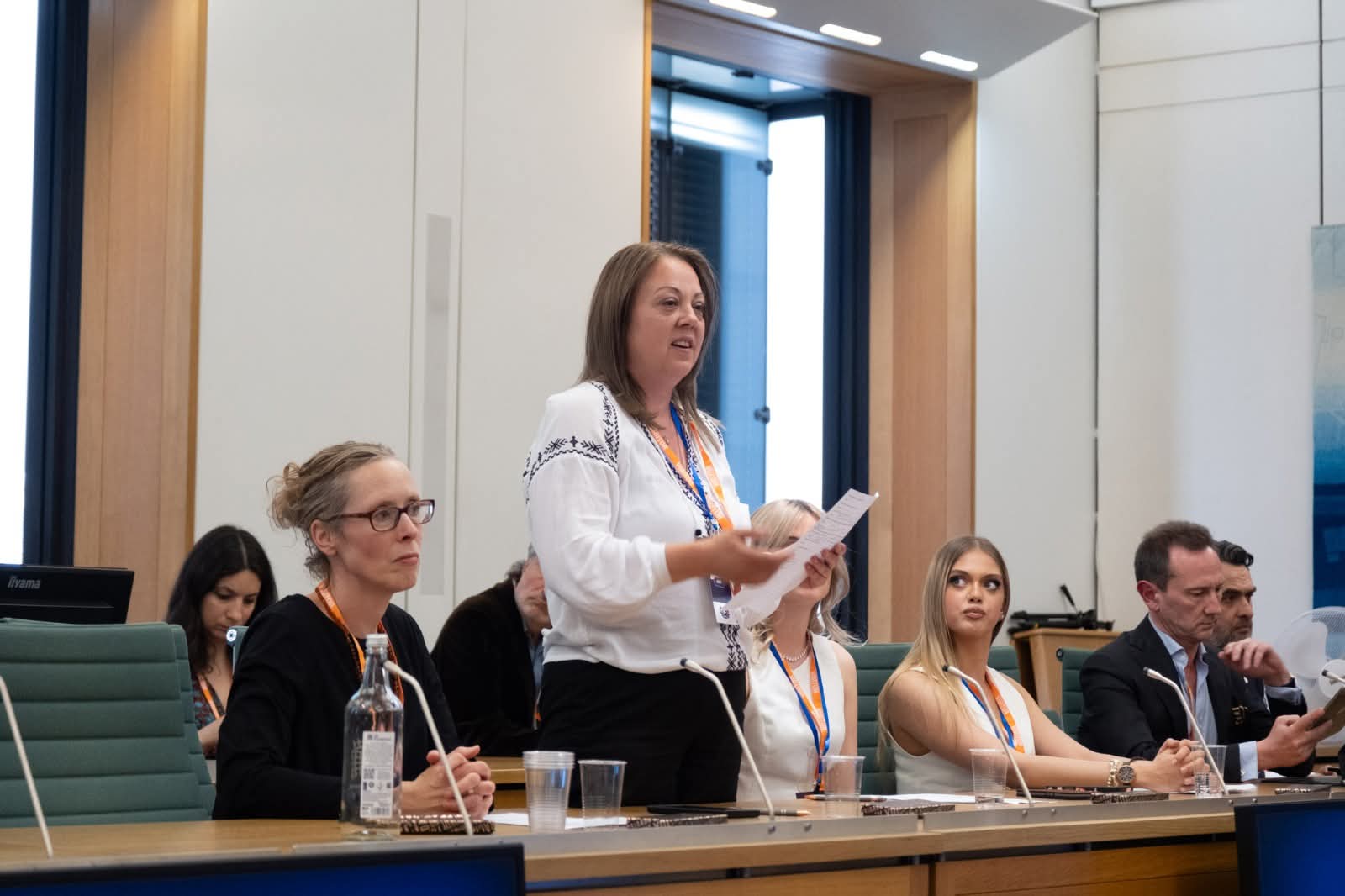
Earlier this year, I joined a growing campaign for the recognition of Romanian. Supporters took this message to Parliament — not as politicians, but as teachers, parents and members of the community. The campaign is run independently, and it is gathering momentum.
Schools are adding their voices and signalling demand to exam boards. Parents across the UK are registering their interest and telling us their children would sit a Romanian GCSE if it existed. Community organisations are helping raise awareness and build the case for recognition nationally.
This is the beginning, not the end. If you agree that Romanian belongs on the GCSE curriculum, you can add your voice.
What Romanian Families Can Do Today
While the campaign works towards official recognition, families do not have to wait to keep their children’s Romanian strong.
At Ciui Training, I have built a Romanian GCSE Preparation Course — Foundation and Higher — with native-quality audio, designed to help heritage learners read, write, speak and grow in confidence in their language. It is the resource I wish my own students had always had. We are currently inviting founding families to join a free pilot.
Because recognition starts at home — and every child deserves to carry their whole identity through the school gate.
Common questions
- Is there a Romanian GCSE in the UK?
- No. Despite Romanian being one of the most widely spoken community languages in the UK, no exam board currently offers a Romanian GCSE, so Romanian-speaking pupils cannot gain a qualification in their home language.
- Why does a heritage-language GCSE matter?
- It converts a skill a child already has into a recognised qualification, which supports their confidence and their record of achievement. Without it, fluency in the home language counts for nothing academically and is more likely to be lost.
Related Blogs
 A Family Holiday in Spain Is GCSE Spanish Speaking Practice — If You Do These 10 Things
Written by Ana-Maria Ciui, a GCSE Spanish teacher and speaking examiner, this article gives ten specific thing...
Jul 14, 2026
A Family Holiday in Spain Is GCSE Spanish Speaking Practice — If You Do These 10 Things
Written by Ana-Maria Ciui, a GCSE Spanish teacher and speaking examiner, this article gives ten specific thing...
Jul 14, 2026
 Police to Teacher – My Unexpected Story – Ana-Maira Ciui – Part 1
The first part of Ana-Maria Ciui's account of moving from the Romanian police force, which she joined after a...
May 27, 2025
Police to Teacher – My Unexpected Story – Ana-Maira Ciui – Part 1
The first part of Ana-Maria Ciui's account of moving from the Romanian police force, which she joined after a...
May 27, 2025
 Polish has a GCSE. Panjabi has a GCSE. Romanian does not.
This article compares the community languages available at GCSE in England — including Polish and Panjabi — wi...
Jul 14, 2026
Polish has a GCSE. Panjabi has a GCSE. Romanian does not.
This article compares the community languages available at GCSE in England — including Polish and Panjabi — wi...
Jul 14, 2026